


Intentional Technology in Schools: Helping Children Learn Wisely

Technology is part of our children's world. From Chromebooks and educational apps to artificial intelligence, today's students have access to tools that would have seemed impossible just a generation ago.
But an interesting conversation is happening among parents and educators: Have schools sometimes confused having more technology with providing better learning?
The answer doesn't require choosing between technology and traditional education. Instead, families and schools can ask a better question: When does technology actually help a child learn?
Intentional Technology in Schools Starts With Purpose
Good education has never been about using the newest tool. It's about choosing the right tool for the student and the learning objective.
Sometimes that may be a computer. Technology can provide access to information, support research, allow students to create something new, and help them develop skills they will need in college and the workplace.
Other times, the best tool may be a pencil, a book, a science experiment, a conversation, or a teacher sitting beside a student.
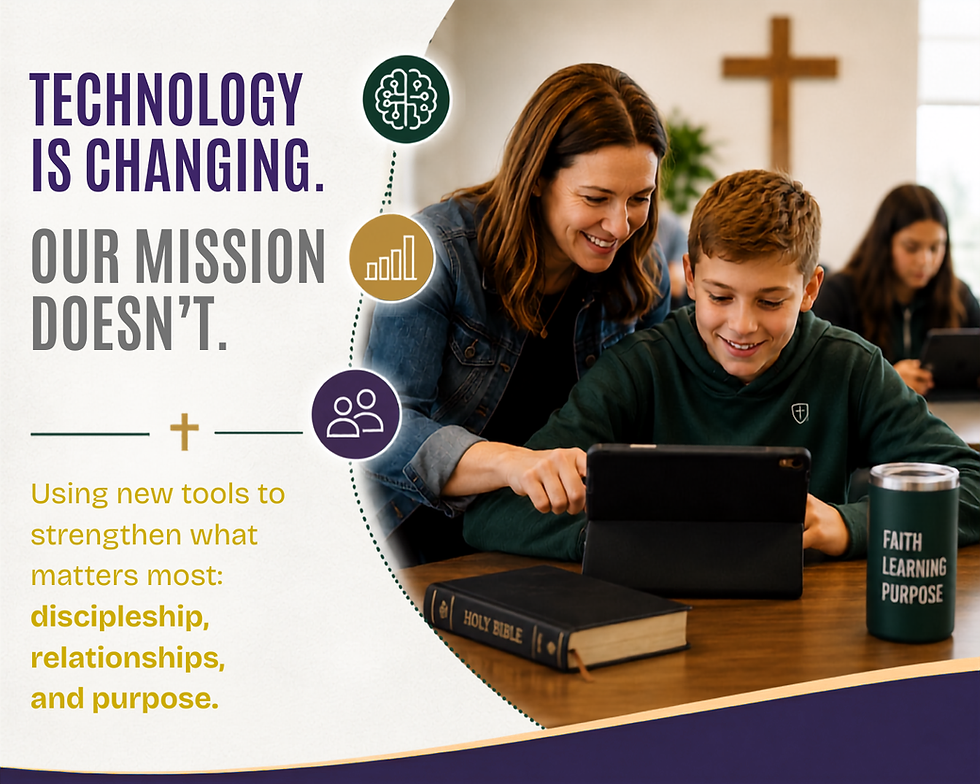
That's the heart of intentional technology in schools. Technology should serve learning rather than determine what learning looks like.
Children Need More Than Information
This distinction matters even more in Christian education because we believe education involves the whole person.
Children aren't simply brains waiting to receive information. They are developing habits, relationships, character, interests, gifts, and an understanding of who they are.
That development happens through human relationships.
A teacher notices when a student is confused even though the assignment says "complete." A classmate asks a question that changes a discussion. Students learn patience when an answer doesn't come immediately. They discover how to listen, disagree respectfully, persevere through difficulty, and ask for help.
Technology can support those experiences, but it cannot replace their importance.
Preparing Children for a Technological World
Reducing unnecessary screen use doesn't mean pretending technology doesn't exist.
In fact, preparing students for a world shaped by artificial intelligence may require something deeper than simply teaching them how to use AI.
Students need wisdom.
They need to know how to evaluate information, recognize when a convenient answer may be wrong, think independently, protect their attention, communicate with real people, and understand when a technological shortcut might prevent them from developing an important skill.
Those are educational questions, but they're also questions of character.
Partnership Matters
Parents shouldn't have to navigate these questions alone, and schools shouldn't either.
Healthy conversations about technology provide another opportunity for parents and educators to work together. Families can ask how and why technology is being used. Teachers can communicate the purpose behind digital tools. Both can reinforce healthy habits surrounding screens, attention, and responsible technology use.
At BG Christian, our mission is to partner with Christian families to develop life-long disciples who know their unique identity and purpose in Christ.
That mission gives technology its proper place.
We want students prepared to use the tools available to them, including powerful new ones. But the goal isn't simply to produce technologically capable graduates.
It's to develop young people with the wisdom to know which tools to use, the character to use them responsibly, and the confidence to put them down when something more important deserves their attention.
Comments